How it is made · Arihant Mills, Ichalkaranji, since 1965

हिन्दी में पढ़ें

Yarn to Handkerchiefs

Follow a cotton hanky through 20 steps, four sections and three quality checks, from the first yarn cone to the dispatched carton.

Every Arihant handkerchief begins as cotton yarn or ready-woven fabric and ends as a checked, packed and dispatched product. Fabric arrives by one of two routes: our production network weaves it from bought yarn, or greige cloth is bought ready from weavers. Both routes meet at Mending.

Colour is created in four ways. Checks and stripes are yarn-dyed before weaving, plain colours are fabric-dyed during processing, whites are bleached only, and prints are digital, or sublimation on poly-cotton.

Four sections

  • A. Yarn to Fabric: buying, yarn dyeing, warping, sizing, loom set-up and weaving.
  • B. Fabric Processing: cleaning, whitening, colouring and pre-shrinking the cloth.
  • C. Cutting, Stitching & Packing: hemmed, pressed, folded and boxed hankies.
  • D. Final Check & Dispatch: confirming the order and shipping it.
  • Yarn to FabricYarn is tested, dyed for checks, laid into a warp and woven into grey fabric.
  • Fabric ProcessingGrey cloth is cleaned, whitened, coloured, pre-shrunk and finished.
  • Cutting, Stitching & PackingFabric becomes cut, hemmed, pressed, folded and packed handkerchiefs.
  • Final Check & DispatchPacked goods are sampled, matched to the order and shipped.

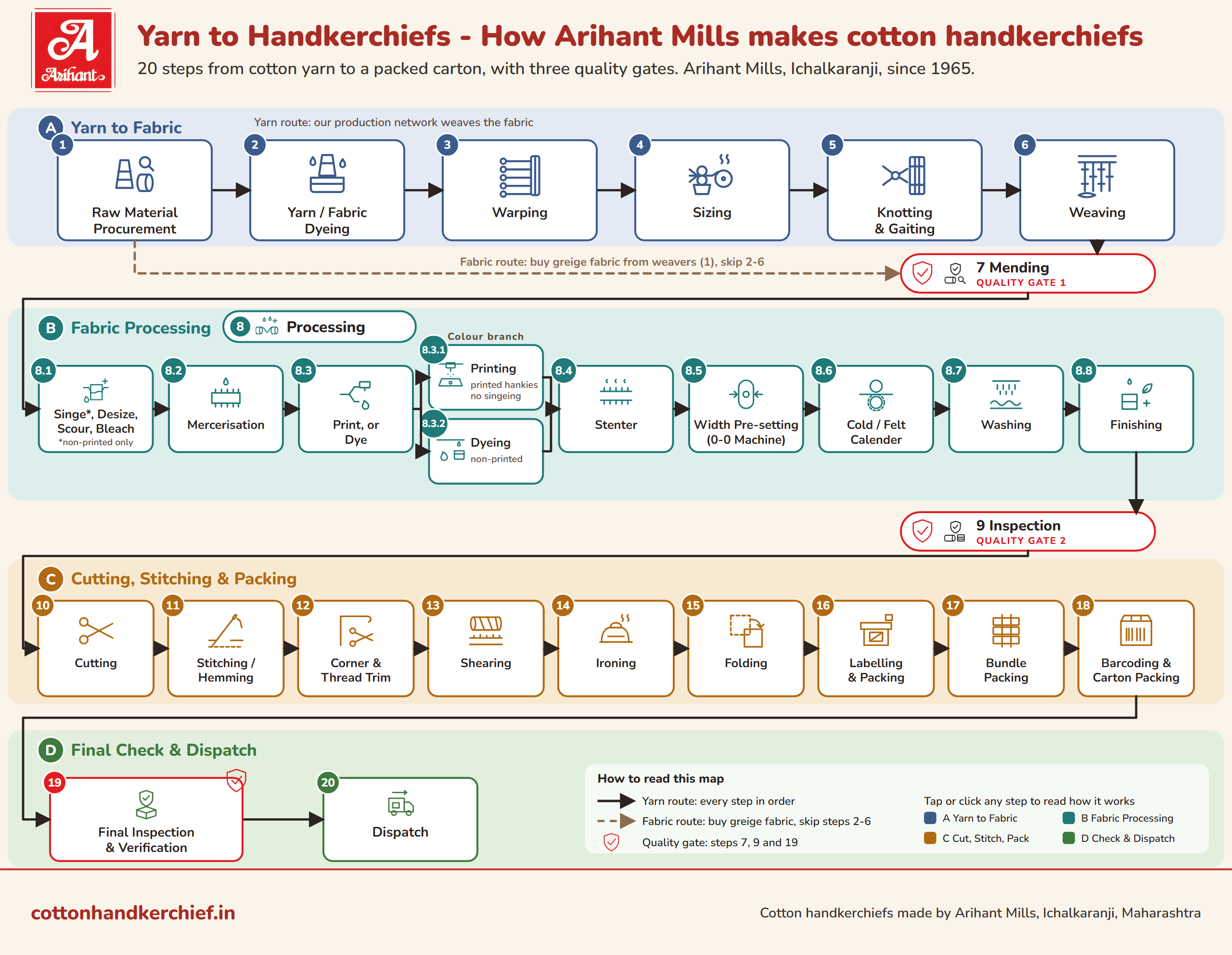
The whole journey on one map

Select any step on the map to read about it. Swipe sideways on a phone.

Yarn to Handkerchiefs: process map of all 20 steps A Yarn to Fabric B Fabric Processing C Cutting, Stitching & Packing D Final Check & Dispatch Raw Material Procurement 1 Yarn / Fabric Dyeing 2 Warping 3 Sizing 4 Knotting & Gaiting 5 Weaving 6 Yarn route: our production network weaves the fabric 7 Mending QUALITY GATE 1 Fabric route: buy greige fabric from weavers (1), skip 2-6 8 Processing Singe*, Desize, Scour, Bleach *non-printed only 8.1 Mercerisation 8.2 Print, or Dye 8.3 Stenter 8.4 Width Pre-setting (0-0 Machine) 8.5 Cold / Felt Calender 8.6 Washing 8.7 Finishing 8.8 Printing printed hankies no singeing 8.3.1 Dyeing non-printed 8.3.2 Colour branch 9 Inspection QUALITY GATE 2 Cutting 10 Stitching / Hemming 11 Corner & Thread Trim 12 Shearing 13 Ironing 14 Folding 15 Labelling & Packing 16 Bundle Packing 17 Barcoding & Carton Packing 18 Final Inspection & Verification 19 Dispatch 20 How to read this map Yarn route: every step in order Fabric route: buy greige fabric, skip steps 2-6 Quality gate: steps 7, 9 and 19 Tap or click any step to read how it works A Yarn to Fabric B Fabric Processing C Cut, Stitch, Pack D Check & Dispatch

Download the infographic Print it or share it with your team:PNG imagePDF

Step by step

Yarn to Fabric

Step 1: Raw Material (Yarn/Fabric) Procurement

Buying and testing the yarn or fabric every hanky starts from

In Cotton yarn or greige fabricOut Tested, approved lots

Every hanky starts with a buying decision. Arihant either buys cotton yarn to weave within our production network, or buys greige fabric, grey cloth straight off the loom, from outside weavers.

What is checked

  • Yarn is tested for count, twist, strength and evenness.
  • Counts in our network range from 20s to 120s; a higher count means a finer yarn.
  • Combed cotton is preferred: combing removes the short fibres and impurities that carded yarn keeps.
  • Bought fabric is checked for ends and picks per inch, width, GSM and visible weaving faults.
  • Moisture is measured, since cotton takes in water from the air (standard regain is about 8.5%).

Uneven yarn later shows up as thick and thin bars across the cloth, so problems are stopped here. Each lot is labelled and stored separately, so shade, count and quality can be traced through every later step.

Compare combed cotton, mercerised and poly-cotton hankies.

Shop by material
Yarn to Fabric

Step 2: Yarn Dyeing / Fabric Dyeing

Colouring yarn for checks, stripes and borders before weaving

In Grey yarn conesOut Dyed yarn cones

Checks, stripes and colour borders get their colour here, before a single thread is woven. This step dyes yarn for our own weaving, and only the yarn for these designs.

How package dyeing works

  • Soft winding puts grey yarn loosely on perforated tubes so dye can flow through.
  • Packages sit on spindles in a closed, pressurised machine; dye is pumped through both ways.
  • Reactive dyes bond chemically with cotton; vat dyes are used where the highest fastness is needed.
  • Rinsing and soaping remove loose dye that could bleed.
  • Each batch is shade-matched under controlled light, then dried and rewound onto firm cones.

Plain colours are not dyed here. On both routes, fabric dyeing takes place inside Processing, at step 8.3.2.

See the checked designs that begin with dyed yarn.

Shop printed & checks hankies
Yarn to Fabric

Step 3: Warping

Laying hundreds of parallel threads onto a beam

In Grey or dyed yarn conesOut Warp beam

The warp is the set of lengthwise threads that runs the full length of the fabric. Warping lays them out side by side, at equal tension, onto a large roller called a beam.

  • Hundreds of cones stand on a creel, a large frame feeding the machine.
  • Direct warping winds the full width in sheets and suits plain warps.
  • Sectional warping builds the beam band by band and suits colour patterns.
  • Each coloured end (single warp thread) follows the design's order, placing stripes and borders.
  • Stop-motions halt the machine when a thread breaks, so it can be joined.

The number of ends, the beam length and the width all come from the fabric's planned construction.

Colour borders are set by the thread order laid here.

See colour-border hankies
Yarn to Fabric

Step 4: Sizing

Coating the warp with a film so it survives weaving

In Warp beamOut Sized weaver's beam

On the loom, each warp thread is rubbed and pulled thousands of times as the weft is beaten in. Bare cotton would fray and snap, so sizing coats it with a thin, temporary film called size.

On the sizing machine

  • Recipes are usually starch-based, often blended with PVA or acrylic binders, plus softener or wax.
  • The warp sheet runs through a hot size box.
  • Squeeze rollers press out the excess; heated cylinders dry the threads.
  • Dried threads are split apart and wound onto the weaver's beam at the set length and width.

The amount picked up, called add-on, is controlled closely. Too little leaves hairy yarn that breaks; too much makes it stiff, brittle and harder to wash out.

Well-sized warp gives the clean, even borders you see on these.

Shop colour-border hankiesSupply to Arihant
Yarn to Fabric

Step 5: Knotting & Gaiting

Tying the new warp to the old and setting up the loom

In Sized weaver's beamOut Loom ready to weave

A loom is threaded with thousands of warp ends. Redoing that by hand for every new beam would take a long time, so the new warp is tied to the old one and the loom is set up again.

  • Knotting: each new end is tied to the matching old end, usually by an automatic machine.
  • The knots are pulled gently through the drop wires, healds and reed, so threading carries over.
  • New designs: each end is drawn in individually, in the order the pattern needs.
  • Gaiting: mounting the beam, levelling the warp sheet, and setting tension, shed and timing.

A heald is a wire that lifts or lowers a thread; the reed is a comb that spaces the threads and beats in the weft.

Every check pattern starts with a perfectly tied-in warp.

Shop printed & checks hankiesApply for job work
Yarn to Fabric

Step 6: Weaving

Interlacing warp and weft into grey fabric

In Warp on loom, weft yarnOut Grey fabric rolls

Weaving interlaces warp and weft into grey fabric. Our production network weaves on dobby, rapier and air-jet looms from makers such as Toyota and Picanol, in widths from 36 to 120 inches.

Three motions, repeated at speed

  • Shedding lifts some warp threads and lowers others to open a gap.
  • Picking passes a weft thread across.
  • Beating-up: the reed presses the weft into place.
  • Ends and picks per inch set the fabric's density, feel and GSM.
  • Stop-motions halt the loom when a thread breaks.

Handkerchief fabrics are mostly plain weave, one over and one under, which gives a light, even and absorbent cloth. Checks are woven on dobby looms, with weft colours changing in a set sequence. Each roll is tagged with its loom and lot.

Soft, absorbent plain-weave cotton, ready for daily use.

Shop everyday cotton hankiesWeavers: supply to Arihant
Quality check 1: MendingQuality check 1 of 3

Step 7: Mending

Checking and grading every grey fabric roll

In Grey fabric rollsOut Checked, graded grey rolls

At Arihant, Mending means the quality check of fabric rolls. It is the first of three quality gates, and every roll passes through it, whether woven in our network or bought as greige cloth.

How a roll is graded

  • Fabric runs over a backlit table that shows up weaving faults.
  • Faults looked for: broken ends, missing picks, floats, holes, oil stains, thick or thin places.
  • Each fault gets 1 to 4 penalty points by length, under the industry 4-point system.
  • Width, length, construction and GSM are checked against the order.
  • Small faults are repaired or marked to be cut away.

Rolls that fail are held back. On the bought-fabric route, this check comes straight after buying.

Need checked, consistent quality in volume? Ask us.

Request a bulk quoteShop all handkerchiefs
Fabric Processing

Step 8: Processing

Cleaning, whitening, colouring and finishing the grey fabric

In Checked grey fabricOut Finished white, dyed, printed fabric

Grey fabric is stiff, off-white and water-repellent. Processing turns it into soft, absorbent, clean fabric in the right colour.

The sequence

  • Singeing, for non-printed fabric only; printed fabric is never singed.
  • Desizing, scouring and bleaching, then mercerisation.
  • The split: printing for printed hankies, dyeing for plain colours.
  • Stenter, width pre-setting on the 0-0 machine, cold or felt calendering, then finishing.
  • Washing, repeated several times along the way.

White and yarn-dyed checked fabric skip both printing and dyeing. Each sub-step has its own controls for temperature, chemicals, time and tension. Shade, width and shrinkage are checked as the fabric moves on. Which sub-steps a lot uses depends on whether it is white, plain coloured, checked or printed.

See the finished results across every range.

Shop all handkerchiefs
Fabric Processing

Step 8.1: Singeing, Desizing, Scouring & Bleaching

Burning off fuzz, then removing size, wax and natural colour

In Grey fabricOut Clean, absorbent white fabric

Four cleaning jobs prepare the cloth for everything after it. Together they leave fabric that is smooth, absorbent and white.

Four jobs, in order

  • Singeing (non-printed lots only): gas flames burn off surface fuzz without scorching the cloth.
  • Desizing: amylase enzymes in warm water break down the size film from step 4.
  • Scouring: a hot caustic soda wash strips out natural waxes and pectins.
  • Bleaching: hydrogen peroxide, kept in check by a stabiliser, removes cotton's creamy colour.
  • Brightening: white hankies often get an optical brightener, which makes white look whiter.

Singeing speed is balanced: too slow scorches, too fast leaves fuzz. Over-bleaching weakens cotton, so whiteness and absorbency are tested. Poly-cotton and yarn-dyed fabrics are treated in much the same way.

White hankies get their colour from bleaching alone.

Shop classic white hankies
Fabric Processing

Step 8.2: Mercerisation

Caustic soda under tension for lustre and strength

In Bleached fabricOut Lustrous, stronger fabric

Under a microscope, a raw cotton fibre looks like a flat, twisted ribbon. Mercerisation changes that shape, and with it the look and strength of the cloth.

How it works

  • Fabric is padded with concentrated caustic soda, typically around 20-30% strength, in the cold.
  • It is held to width under tension throughout.
  • Fibres swell and become rounder and smoother, so they reflect more light.
  • Caustic is washed off under tension, then neutralised with a mild acid.

What it gives

  • A silky lustre.
  • Higher strength.
  • Better dye uptake: deeper colour from less dye.
  • More stable dimensions.

This step is what gives mercerised hankies their soft sheen, and why their colours stay richer over many washes.

Feel the sheen this step gives to cotton.

Shop mercerised hankies
Fabric Processing

Step 8.3: Printing or Dyeing

The colour route splits: print, dye, or neither

Step 8.3 splits in two: choose the printed route (8.3.1) or the non-printed route (8.3.2).

In Mercerised fabricOut Printed or dyed fabric

After mercerisation the path divides according to how the hanky gets its colour. After this point, every lot rejoins the common line at the stenter. Matching the method to the design matters.

Four products, three paths

  • Printed hankies: branch 8.3.1, digital inkjet, or sublimation on poly-cotton only.
  • Plain-coloured hankies: branch 8.3.2, the whole fabric dyed in one even shade.
  • White hankies: neither branch; colour comes from bleaching alone.
  • Yarn-dyed checks: neither branch; colour was woven in from yarn dyed at step 2.

Fabric dyeing happens in branch 8.3.2, whether the cloth was woven in our network or bought as greige. Printed fabric reaches this point unsinged.

Choose white, coloured, bordered or printed styles.

Shop by colour
Fabric Processing

Step 8.3.1: Printing

Digital inkjet on cotton, or sublimation on poly-cotton

In Prepared white fabricOut Printed fabric

Two printing methods are used, chosen by fabric. Matching the method to the fibre is what makes the print last.

Digital printing (cotton)

  • Print heads spray tiny ink drops straight from a computer file; no screens needed.
  • Cotton gets reactive inks over a print pre-treatment.
  • Steam fixes the colour; loose dye is then washed out.

Sublimation (poly-cotton)

  • The design is printed on paper first.
  • Heat and pressure, typically around 180-210 °C, turn the dye into gas.
  • The gas enters polyester fibres only, so it is used only on poly-cotton.

Prints are checked against the approved strike-off for misregistration, banding (lines from blocked nozzles) and bleeding. Colours are also checked against the approved design.

See a printed poly-cotton hanky made this way.

Shop printed poly-cotton hankies
Fabric Processing

Step 8.3.2: Dyeing

Dyeing the whole fabric in one plain colour

In Mercerised fabricOut Plain-dyed fabric

Plain-coloured hankies get their colour here, with the whole fabric dyed in one shade. This is where fabric is dyed on both routes, and our production network offers more than 50 colours.

How plain colours are dyed

  • Reactive dyes bond chemically with cotton.
  • Salt helps the dye move onto the fibre; alkali then fixes it.
  • A jigger winds open-width fabric back and forth through the dye bath.
  • Washing and soaping remove dye that has not bonded.
  • Shade is matched in a light box; levelness is checked across width and batch.

White and yarn-dyed checked fabrics skip this step: whites get their colour from bleaching, and checks from yarn dyed at step 2.

Plain colours are fabric-dyed in this branch.

Shop dark colour hankies
Fabric Processing

Step 8.4: Stenter

Drying the fabric and setting an even width

In Wet processed fabricOut Dried fabric at set width

A stenter dries wet fabric and sets its width in one pass. Straight threads and a correct width are what make a true, square hanky. The edges are held all the way, so the cloth dries at exactly the set width.

How it works

  • Pins or clips on two chains grip the fabric edges.
  • The chains carry it through hot-air chambers, spaced to the target width.
  • A weft straightener corrects bow and skew, when crosswise threads curve or slant.
  • A padding mangle at the entry can apply finishes such as softener.
  • Overfeed feeds fabric in slightly faster than it leaves, for controlled lengthwise relaxation.

Overfeed, temperature and speed are set together to control length shrinkage and avoid over-drying the cotton.

Accurate width lets each hanky size come out true.

Shop by size
Fabric Processing

Step 8.5: Width Pre-setting (0-0 Machine)

One machine that pre-shrinks fabric so it keeps its shape

In Stentered fabricOut Pre-shrunk, shape-set fabric

Weaving and wet processing stretch cotton lengthwise. Left as it is, a hanky would shrink the first time it is washed. At Arihant, width pre-setting is the step that prevents this, done on one machine.

How it works

  • The machine is the 0-0 (zero-zero) compressive pre-shrinking machine, or compactor.
  • Fabric is compressed lengthwise between a heated cylinder and a thick rubber belt or felt.
  • The pressure pushes threads closer together, taking out shrinkage mechanically.
  • Washed samples are typically re-measured to check the result.

'Zero-zero' names the aim: near-zero residual shrinkage, meaning what fabric would still lose in a home wash, in both length and width. No chemicals are involved.

Pre-shrunk fabric means the size you buy is the size you keep.

Shop by sizeWash & care tips
Fabric Processing

Step 8.6: Cold / Felt Calender

Pressing between rollers for a smooth, soft feel

In Pre-shrunk fabricOut Smooth, compact fabric

Calendering presses fabric between rollers to flatten and smooth its surface. Both kinds below are used at Arihant, and the choice is made for each product.

Two finishes

  • Felt calender: a heated drum and a thick, endless felt blanket press the fabric.
  • It gives a full, slightly compact handle with a gentle lustre.
  • Cold calender: pressure without heat, smoothing the surface without adding shine.
  • Pressure, temperature and speed are set for each fabric quality.

Handle is the trade word for how a fabric feels in the hand. A felt-calendered hanky feels fuller and softer; a cold-calendered one is smooth without extra shine.

Finishing gives premium hankies their soft handle.

Explore the premium collection
Fabric Processing

Step 8.7: Washing

A wash repeated through processing to rinse fabric clean

In Fabric between processesOut Clean, neutral fabric

Washing is not a single stop on the line. Fabric is washed several times through processing, wherever chemicals, unfixed dye or loose fibres need to come out.

What washing does

  • Re-washing: process houses re-wash lots when a customer needs it.
  • Waiting lots are also re-washed when fabric has waited between processes.
  • Soaping, a hot wash with detergent, removes colour not bonded to the fibre.
  • Each wash brings the fabric towards a near-neutral pH, around 7.
  • Wash water clarity and fabric pH are checked before the fabric moves on.

Clear wash water shows that loose dye and chemicals have gone. pH measures how acidic or alkaline something is, on a scale where around 7 is neutral.

Clean washing keeps light shades fresh and even.

Shop light colour hankiesWash & care tips
Fabric Processing

Step 8.8: Finishing

Optional enzyme wash and finishes on request, then drying

In Washed fabricOut Finished fabric rolls

The last processing stage adds optional extras, then dries the cloth. The finished rolls go on to the second quality check.

Finishing, step by step

  • Enzyme wash (bio-polishing): cellulase enzymes remove tiny surface fibres for a softer feel.
  • Dosage and time are controlled, because too much enzyme weakens the fabric.
  • Value-added finishes (softener, antibacterial, silver, fragrance) are applied only when a customer asks.
  • Padding applies them: fabric runs through a bath and squeeze rollers.
  • Rolls are dried, labelled by lot and sent to inspection at step 9.

The enzyme wash leaves a cleaner surface, a softer feel and less pilling, the small balls of fibre that form with wear. Labelling by lot means each roll can be traced.

Special finishes are made to order for bulk lots.

Request a bulk quoteShop all handkerchiefs
Quality check 2: InspectionQuality check 2 of 3

Step 9: Inspection

Checking the finished fabric before it is cut

In Finished fabric rollsOut Approved fabric for cutting

The second quality gate repeats the Mending check, this time on finished fabric. Every roll runs over a lit table again.

What is checked

  • Processing faults: stains, uneven shade, creases, holes, pin marks, bowed or skewed weft.
  • Shade is compared with the approved standard in a light box under standard daylight.
  • Batches are kept apart so one order does not mix shades.
  • Samples are tested for width, GSM, residual shrinkage and colour fastness.
  • Faulty areas are marked to be cut away; failed rolls are re-processed or rejected.

Colour fastness is how well colour resists washing and rubbing. Only approved fabric goes on to cutting. Rolls that fail never reach the cutting floor.

Tell us your shade, size and test needs.

Request a bulk quoteShop all handkerchiefs
Cutting, Stitching & Packing

Step 10: Cutting

Cutting fabric into accurate squares for each size

In Approved fabric rollsOut Cut fabric squares

Cutting decides the size of every hanky. Each square is cut slightly larger than the finished hanky, to include the hem allowance folded in at step 11.

How it is done

  • Fabric is spread flat in layers, or slit into strips the width of the hanky.
  • Strips are cut across into squares.
  • Cuts follow the grain, the direction of the warp and weft threads.
  • Border fabric is lined up so the border falls evenly on all four sides.
  • Samples are measured regularly; faults marked at inspection are cut out.

Strips and squares are cut with straight-knife or band-knife cutters against measuring templates, so sizes stay within tolerance across a whole order. Size accuracy here depends on the straight, square fabric set at the stenter.

Find the hanky size that suits you.

Shop by size
Cutting, Stitching & Packing

Step 11: Stitching / Sewing / Hemming

Folding and stitching the edges so they never fray

In Cut fabric squaresOut Hemmed handkerchiefs

A cut edge frays; hemming stops that for good. The raw edge is turned over twice so no cut edge is exposed, then stitched down. The hem is what holds the hanky together through years of washing.

How the hem is made

  • A folder attachment on a single-needle lockstitch machine turns the edge.
  • Lockstitch interlocks a needle thread with a bobbin thread for a strong, flat seam.
  • Thread colour and type are matched to the fabric and border.
  • Stitch density and tension are set to avoid puckering.
  • Corners are turned neatly so they lie flat, not bulky.

Hem width defines the style: narrow classic stitch, wide classic stitch or wide hemmed traditional. Line checkers watch for skipped stitches, open seams and uneven hems.

Narrow or wide: the hem style is chosen here.

Shop by stitch style
Cutting, Stitching & Packing

Step 12: Corner & Thread Trimming

Cutting loose thread ends and tidying the corners

In Hemmed handkerchiefsOut Trimmed handkerchiefs

Sewing leaves small loose ends behind, at the corners and wherever a seam starts or stops. This step cleans them up by hand.

What happens

  • Thread tails and short stitch chains are trimmed close with nippers.
  • Care is taken never to cut into the stitches that hold the hem.
  • Each corner is checked to be square, flat and securely stitched.
  • A thread suction machine can lift trimmed ends away.
  • Hankies with open stitches or poor corners go back for repair.

It is quick, careful hand work done piece by piece. A hanky that leaves this table has square corners, a secure hem and no loose tails, ready for shearing, the machine clean-up that follows.

Neat corners show best on a fine narrow hem.

Shop narrow classic stitch
Cutting, Stitching & Packing

Step 13: Shearing

A machine cuts loose fibres off the hanky surface

In Trimmed handkerchiefsOut Clean-surfaced handkerchiefs

Shearing is a machine clean-up of the surface of sewn handkerchiefs. It removes what hand trimming leaves behind. It reaches the whole surface in a single pass, not just the corners and seams.

How it works

  • A rotating spiral blade works against a fixed ledger blade, like a cylinder lawn mower.
  • It snips off fibres and stray threads standing up from the cloth.
  • One pass removes lint, the tiny loose fibres, plus leftover thread ends.
  • The blade gap is set to catch loose fibres but never cut fabric or stitches.

Blade sharpness and setting are checked regularly. A dull blade leaves fuzz; a blade set too low can nick the fabric. Hem stitches must be left untouched.

Every everyday hanky gets this clean finish.

Shop everyday cotton
Cutting, Stitching & Packing

Step 14: Ironing

Pressing each hanky flat and crisp with steam

In Sheared handkerchiefsOut Pressed, flat handkerchiefs

Each hanky is pressed with steam. Heat and moisture relax the cotton fibres, so creases come out and hems lie flat. This is the step that turns a clean hanky into a crisp, ready-to-use one.

How it is done

  • Cotton tolerates a hot iron.
  • Poly-cotton is pressed cooler, since polyester can turn shiny or melt.
  • Vacuum tables suck air down through the fabric, pulling steam and moisture through.
  • The hanky sets flat and cools quickly, without new creases.
  • Operators check for scorch marks and shine.

Pressing also squares the hanky, which makes the next step, folding, accurate. Temperature is chosen by fabric before pressing begins, and every piece passes under the iron, so a whole packet looks the same.

Browse crisp, ready-to-use hankies.

Shop all handkerchiefs
Cutting, Stitching & Packing

Step 15: Folding

Folding every hanky to the same neat size

In Pressed handkerchiefsOut Folded handkerchiefs

Folding gives every hanky the same shape and size, so each one fits its box or pack exactly.

How it is done

  • Folders work with templates, boards cut to the exact folded size.
  • The fold is planned so the border and design show through the pack window.
  • Some packs use a rolled hanky, such as the slim single-hanky window box.
  • Each hanky gets a last look for stains or faults; any problem piece is set aside.

Folding is the last moment a person handles each hanky on its own, so it doubles as a final look for faults before the hanky goes into its pack. Box, hanging and gift packs each have their own fold size.

Neatly folded multi-packs for everyday buying.

Shop value range
Cutting, Stitching & Packing

Step 16: Labelling & Packing

Putting each hanky into its branded, labelled pack

In Folded handkerchiefsOut Labelled retail packs

Each range has its own pack, and each pack carries the details a buyer and the law expect. Packs are chosen to suit shelf display, hanging display or gifting. The pack, in turn, sets how the hanky is folded at step 15.

Pack types

  • Slim single-hanky window box, with a rolled hanky.
  • Box of 12 singles.
  • 3-piece hanging pack for display hooks.
  • The classic Arihant hanky box of 3 pieces.
  • Maroon premium gift box, shrink-wrapped, also used for corporate gift sets.

Labels carry product details, the line 'Manufactured by Arihant Mills, Ichalkaranji' and care symbols, icons for washing, drying and ironing. Packaged retail goods in India also carry Legal Metrology declarations such as quantity, MRP and maker details.

Our premium range, well suited to gifting.

Explore the premium collectionCorporate gifting
Cutting, Stitching & Packing

Step 17: Bundle Packing

Grouping packs into bundles and bales for trade

In Labelled retail packsOut Bundles and bales

Goods leave our production network in three formats: box packs, bundle packs and bale packs. Here, boxed retail packs become trade units.

How it is done

  • Packs are grouped by design, size and colour into bundles of a fixed count, such as dozens.
  • Bulk goods are pressed into bales, wrapped in woven HDPE and strapped.
  • Each bale is marked with the Arihant Mills logo and address.
  • Bundle contents are counted and recorded against the order.

HDPE is high-density polyethylene, a strong woven plastic. The wrap protects goods from dust, moisture and knocks in transit and storage. Each bundle holds a single design, size and colour, so stock is easy to sort on arrival. Bale packs suit large bulk orders.

Bundled by the dozen, ready for shops and bulk buyers.

Shop the value rangeWholesale buying guide
Cutting, Stitching & Packing

Step 18: Barcoding & Carton Packing

Barcoding cartons and packing them for transit

In Bundles and packsOut Barcoded, sealed cartons

Every carton gets an internal barcode, so it can be scanned and tracked from the packing floor to the buyer. Barcodes here are internal, used to track cartons against orders.

How it is done

  • Packs go into printed corrugated cartons with the red square Arihant Mills logo.
  • Cartons are filled firmly, sealed and strapped to stop crushing in transit.
  • Each carton is marked with contents, quantity and order details.
  • Scanning matches every carton to the packing list.

The packing list is the document that records what is in each carton of a shipment. A missing, extra or wrongly filled carton shows up before the goods leave. It is checked by scanning, not by memory.

Need barcoded cartons for your stores? Ask us.

Request a bulk quoteShop all handkerchiefs
Final Check & DispatchQuality check 3 of 3

Step 19: Final Inspection & Verification

A last check of packed goods against the order

In Packed cartonsOut Verified, released shipment

The third quality gate looks at goods exactly as a buyer will receive them. Cartons are opened at random and a sample is inspected.

What is checked

  • Sample size and fault limits commonly follow AQL sampling (ISO 2859-1).
  • Checks: size, stitching, shade match, stains, folding and packing.
  • Labels, barcodes and carton quantity are also checked.
  • Verification matches goods with the order and packing list by design, size, colour and count.
  • A failed lot is held, re-checked and corrected before release.

AQL stands for Acceptable Quality Limit. A planned sample gives a sound verdict on a whole lot without unpacking every box. It is the last chance to catch a fault before the goods leave Ichalkaranji.

State your own inspection or AQL needs.

Request a bulk quoteShop all handkerchiefs
Final Check & Dispatch

Step 20: Dispatch

Loading and shipping orders from Ichalkaranji

In Verified cartons and balesOut Shipment on its way

Dispatch starts with counting and weighing. Cartons and bales are loaded with heavy items at the bottom, so nothing shifts or crushes on the road. Every piece is accounted for.

Documents with every dispatch

  • GST invoice.
  • Packing list.
  • Lorry receipt (LR), the transporter's confirmation that goods were handed over.
  • E-way bill, an electronic document needed under GST for goods above a set value.

Each carton and bale carries its internal barcode, so it is matched to the packing list as it is loaded.

Orders leave Ichalkaranji by road transport or courier, to traders, retailers, institutions and online customers. Tracking details are shared with the buyer, so they can follow the shipment until it arrives.

Ready to order? Start with a bulk quote.

Request a bulk quoteShop all handkerchiefs

From one thread to a finished hanky

A plain cotton handkerchief carries more work than it shows. Arihant Mills has followed this path in Ichalkaranji since 1965, across our own units and partner units in the cluster.

  • Softness is set by the yarn; straight lines by the warp.
  • Feel comes from processing; size from pre-shrinking and careful cutting.
  • Three quality checks stand between the loom and your hands.

Shop all handkerchiefsRequest a bulk quote

Questions people ask

Where are Arihant handkerchiefs made?

In Ichalkaranji, Maharashtra, where Arihant Mills has worked since 1965. Our production network, across own and partner units, weaves fabric 36 to 120 inches wide and 80 to 600 GSM, from 20s to 120s yarn, in more than 50 colours.

Where does a hanky's colour come from?

Checks and stripes are yarn-dyed before weaving, so the pattern is woven in. Plain colours are fabric-dyed during processing, on both material routes. Whites are bleached only. Prints are digital, or sublimation on poly-cotton.

Why does the hanky keep its size after washing?

Before cutting, the fabric goes through width pre-setting on the zero-zero (0-0) compressive pre-shrinking machine, which pushes the threads closer together lengthwise. The aim is near-zero residual shrinkage, so the hanky keeps its shape after washing and use.

What is mercerised cotton?

Cotton treated with strong caustic soda while held under tension. The fibres swell from flat ribbons into rounder, smoother fibres, giving a silky lustre, more strength and deeper, richer colour.

Can sublimation printing be used on 100% cotton?

No. Sublimation dye bonds only with polyester, so on pure cotton the print would wash out. Arihant uses sublimation only on poly-cotton and prints cotton digitally with reactive inks.

How is quality checked?

At three gates: Mending checks every grey fabric roll, Inspection checks the finished fabric for faults, shade, shrinkage and fastness, and Final Inspection & Verification samples packed goods, commonly by AQL, and matches them to the order.

Glossary Words used in this guide
Yarn count
A number for how fine a yarn is; in the cotton (Ne) system, a higher count means a finer yarn.
Greige / grey fabric
Cloth straight off the loom, before washing, bleaching or dyeing.
Combed cotton
Cotton yarn with short fibres combed out, so it is smoother and stronger.
GSM
Grams per square metre: how heavy (and roughly how thick) a fabric is.
Yarn dyeing
Colouring the yarn before weaving, so patterns are woven in rather than printed on.
Package dyeing
Dyeing yarn wound on perforated tubes by pumping dye through it in a closed machine.
Reactive dye
A dye that chemically bonds with cotton, giving bright, wash-fast colour.
Colour fastness
How well a colour resists fading or bleeding in washing, rubbing or light.
Warp
The lengthwise threads held tight on the loom.
Ends
Individual warp threads.
Creel
The large stand that holds the yarn cones feeding the warping machine.
Beam
A large roller onto which the warp is wound.
Size
A temporary starch-based coating that strengthens warp yarn for weaving.
Add-on
How much size the yarn picks up, as a percentage of yarn weight.
Weaver's beam
The sized warp beam that is mounted on the loom.
Knotting (tying-in)
Joining each new warp thread to the old one so the loom keeps its threading.
Gaiting
Mill term for setting up and adjusting a loom with a new beam.
Heald
A wire with an eye that lifts or lowers a warp thread to make the opening for the weft.
Reed
A comb-like frame that spaces the warp threads and beats each weft into place.
Weft (pick)
The crosswise thread passed through the warp; one crossing is one pick.
Plain weave
The simplest weave: each weft goes over one warp and under the next.
Shed
The opening between raised and lowered warp threads where the weft passes.
Construction
A fabric's ends and picks per inch and yarn counts.
Mending (Arihant usage)
Quality check of fabric rolls for faults; traditionally also the hand repair of small weaving faults.
4-point system
A common fabric grading method that gives 1-4 penalty points per fault by its size.
Float
A thread that skips over several threads instead of interlacing.
Wet processing
All the washing, bleaching, dyeing, printing and finishing done to fabric after weaving.
Pretreatment
Cleaning steps (desizing, scouring, bleaching) that prepare fabric for colour and finishing.
Singeing
Burning off loose surface fibres with a gas flame for a smooth fabric.
Desizing
Removing the temporary size coating from woven fabric.
Scouring
Hot alkaline cleaning that removes natural wax and dirt from cotton.
Optical brightener
A finish that turns invisible UV light into blue light, so white looks whiter.
Mercerisation
Treating cotton with caustic soda under tension to make it lustrous, stronger and easier to dye.
Lustre
The soft shine of a fabric surface.
Digital printing
Inkjet printing of a design directly onto fabric from a computer file.
Sublimation
Heat-transfer printing where dye turns to gas and enters polyester fibres; it does not work on cotton.
Poly-cotton
Fabric made from a blend of polyester and cotton.
Strike-off
A short sample print approved before the full run.
Fabric dyeing (piece dyeing)
Dyeing the woven fabric in one colour.
Shade matching
Comparing the dyed colour with the approved standard under controlled light.
Jigger
A dyeing machine that winds open-width fabric back and forth through a dye bath.
Stenter (tenter)
A machine that holds fabric by its edges while drying it to a fixed width.
Bow and skew
Crosswise threads curved or slanted instead of straight across.
Overfeed
Feeding fabric in slightly faster than it leaves, to allow controlled lengthwise relaxation.
0-0 machine
Zero-zero compressive pre-shrinking machine (compactor) that removes shrinkage before sewing.
Residual shrinkage
How much a fabric still shrinks when washed by the end user.
Calendering
Pressing fabric between rollers to smooth it or add lustre.
Felt calender
A calender where a heated drum and a felt blanket press the fabric for a soft finish.
Handle (hand feel)
How a fabric feels when touched.
Soaping
Hot washing with detergent to remove loose dye after dyeing or printing.
pH
A scale for acidity or alkalinity; around 7 is neutral.
Enzyme wash (bio-polishing)
Using natural enzymes to clean fuzz off the cotton surface for a smoother, softer feel.
Softener
A finish that makes fabric feel softer.
Antibacterial finish
An optional finish applied on a customer's request, meant to limit bacteria on fabric.
Light box
A cabinet with standard lights to compare colours fairly.
Rubbing fastness
How well colour resists rubbing off onto another cloth.
Grain
The direction of the warp and weft threads in a fabric.
Hem allowance
Extra fabric left at the edge to fold over and stitch.
Hem
An edge folded over and stitched to stop fraying.
Lockstitch
A strong stitch formed by interlocking a needle thread and a bobbin thread.
Puckering
Small wrinkles along a seam from wrong tension or feeding.
Thread tail
Loose end of sewing thread left after stitching.
Shearing
Machine cutting of loose fibres and threads off a fabric surface.
Lint
Tiny loose fibres on fabric.
Vacuum table
An ironing table that sucks air through the fabric to set the press.
Folding template
A board or guide that makes every fold the same size.
MRP
Maximum Retail Price printed on packs sold in India.
Care symbols
Small icons showing how to wash, dry and iron the product.
Bale
A tightly pressed, wrapped and strapped bundle of goods for transport.
HDPE
High-density polyethylene: the strong woven plastic used for bale wrap.
Internal barcode
A barcode Arihant prints on each carton to identify and track it against the order.
Packing list
A document listing what is in each carton of a shipment.
AQL
Acceptable Quality Limit: a sampling method that decides how many pieces to check and how many faults are allowed.
Verification
Confirming the goods match the order and documents.
E-way bill
An electronic document required under GST for moving goods above a set value.
Lorry receipt (LR)
The transporter's receipt for goods taken for delivery.